The India-Singapore Production Bridge
Why this corridor is the best-kept secret in Asian content.
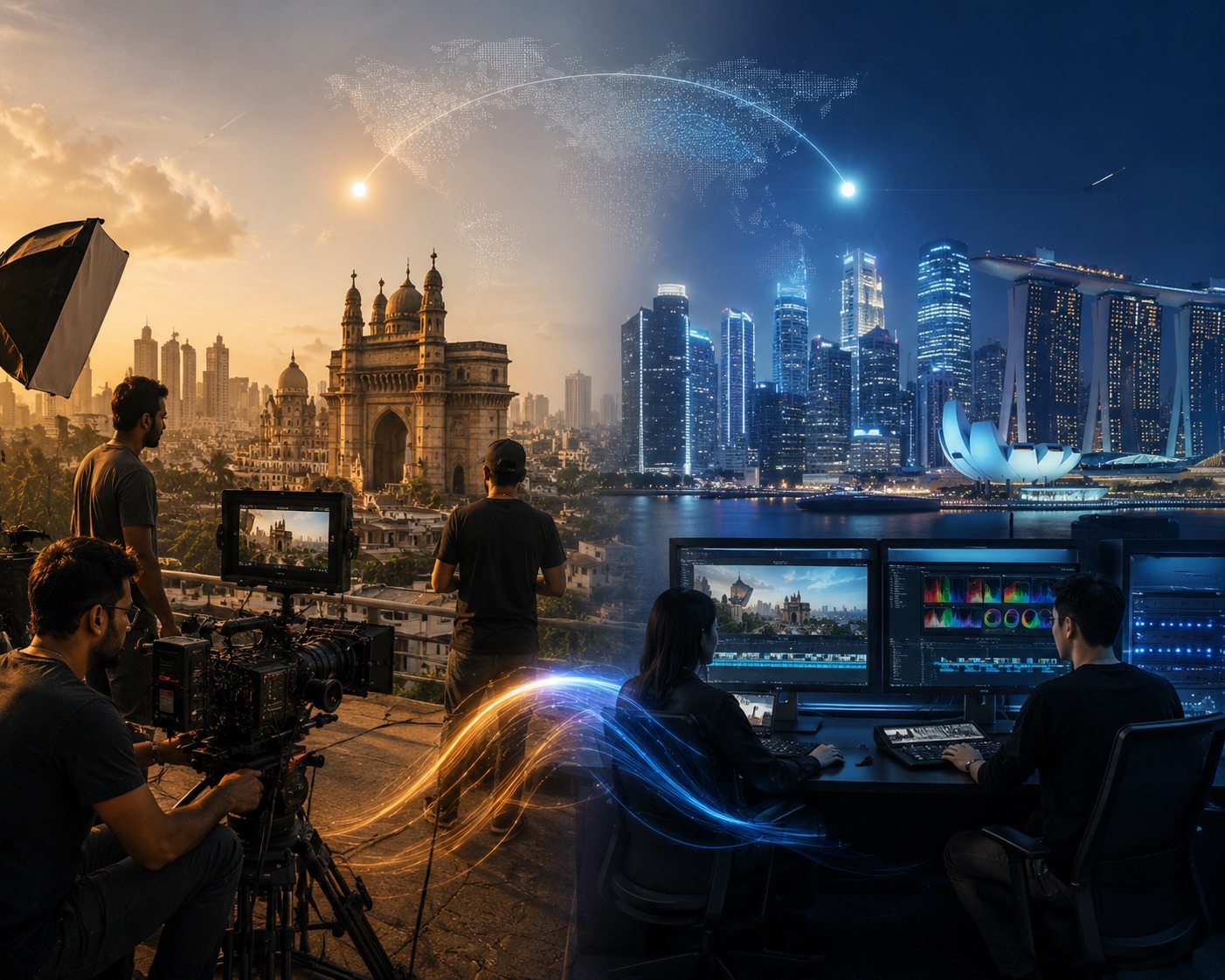
I walked onto a set in Mumbai at 4pm. The chai boy meets me first with a cup of chai. Not in a paper cup. In a proper cup. Then the meeting starts, after the cup arrives.
The brief was a two-level living room. Full build, studio set. The walls were just being erected. The art director walked me through the references, the props team had swatches out, and we sat drinking cutting chai while they talked me through the plan.
I came back the next morning for the pre-pro. The entire set was finished. Two levels. Dressed. Lit. In less than 24 hours.
Speed that comes from abundance
I have lived in Singapore for over a decade. Before that, Oslo. Before that, Australia and Bombay somewhere in between. I have worked on sets in all of them. That turnaround does not exist anywhere else I have worked. It is not even a conversation.
What India gives you is speed that comes from abundance — abundance of craft, of people who grew up building things with their hands, of art directors who have dressed a hundred sets and do not need a week to think about it. The depth of the talent pool is staggering. Not just in Mumbai — in Hyderabad, Chennai, Bangalore. Post-production houses that have been trained on the world's most demanding streaming platforms now operate at the level of London or LA shops, at a fraction of the cost.
This is not about cheap labour. That framing misses the point entirely. This is about a generation of craftspeople who came up through one of the most prolific film industries on earth and are now applying that experience to global-standard commercial work. The quality is not a surprise to anyone who has actually worked there. It is only a surprise to people who have not.
What Scandinavia taught me
What Oslo gave me is different. The quietness of brilliance. Less chatter, more finished visual communication. A wide space for creative independence. Every frame considered. Nothing wasted.
Scandinavian production culture is built on restraint. Not restraint as limitation — restraint as discipline. The brief is respected. The frame is clean. The edit is tight. There is no fat on the work, because nobody confuses more footage with more value.
I love both. That is what Bombay Blanc is — India's speed and depth, held to a standard I learned in Scandinavia.
The corridor nobody is talking about
The India-Singapore production corridor is, right now, the most undervalued creative pathway in Asia. Singapore provides the commercial credibility, the proximity to Southeast Asian markets, and the business infrastructure. India provides the craft, the post-production pipeline, and the depth of creative talent. Together, they offer something that neither city can offer alone: world-class production at a price point that lets you do more with the same budget.
For European and Australian brands entering Southeast Asia, this corridor solves a problem that nobody has cleanly addressed. You want quality that matches what you are used to at home. You want someone on the ground who understands both sides of the cultural equation. You want a production partner who can shoot in Mumbai on Tuesday and deliver a grade from Singapore on Thursday.
That is the bridge Bombay Blanc was built to be.
The bridge is a person
A corridor is only as useful as the person standing in it. Someone who has sat in both rooms — the production meeting in Andheri and the grade review in Singapore — and can hold the standard across both.
I have been that person for twenty years. Not because I planned it, but because I kept ending up on sets in cities that do not usually share a production pipeline. Oslo. Mumbai. Sydney. Singapore. After enough crossings, the bridge is not a strategy. It is a biography.
The chai is ready. Come.
Planning a production in Asia?
Start a conversation. →More from the Journal
Two Walls and a Lie Cinema Kept Breaking the Wrong Wall The Fifth Wall Breaking the Fifth Wall